 “I took a bite of my sandwich, unwrapped my sandwich in the wax paper, took a bite, left the sandwich exposed while I was chewing and swallowing. And I turned back to the sandwich—and the white bread had become discolored because of so much dust. “And the guy sitting next to me, the guy from Scotland, laughed at me. ‘Don’t you know,’ he said, ‘laddie, you’ve got to wrap your sandwich back up while you chew and swallow.’ I wanted then to go home.”
—Chuck Martin oral history
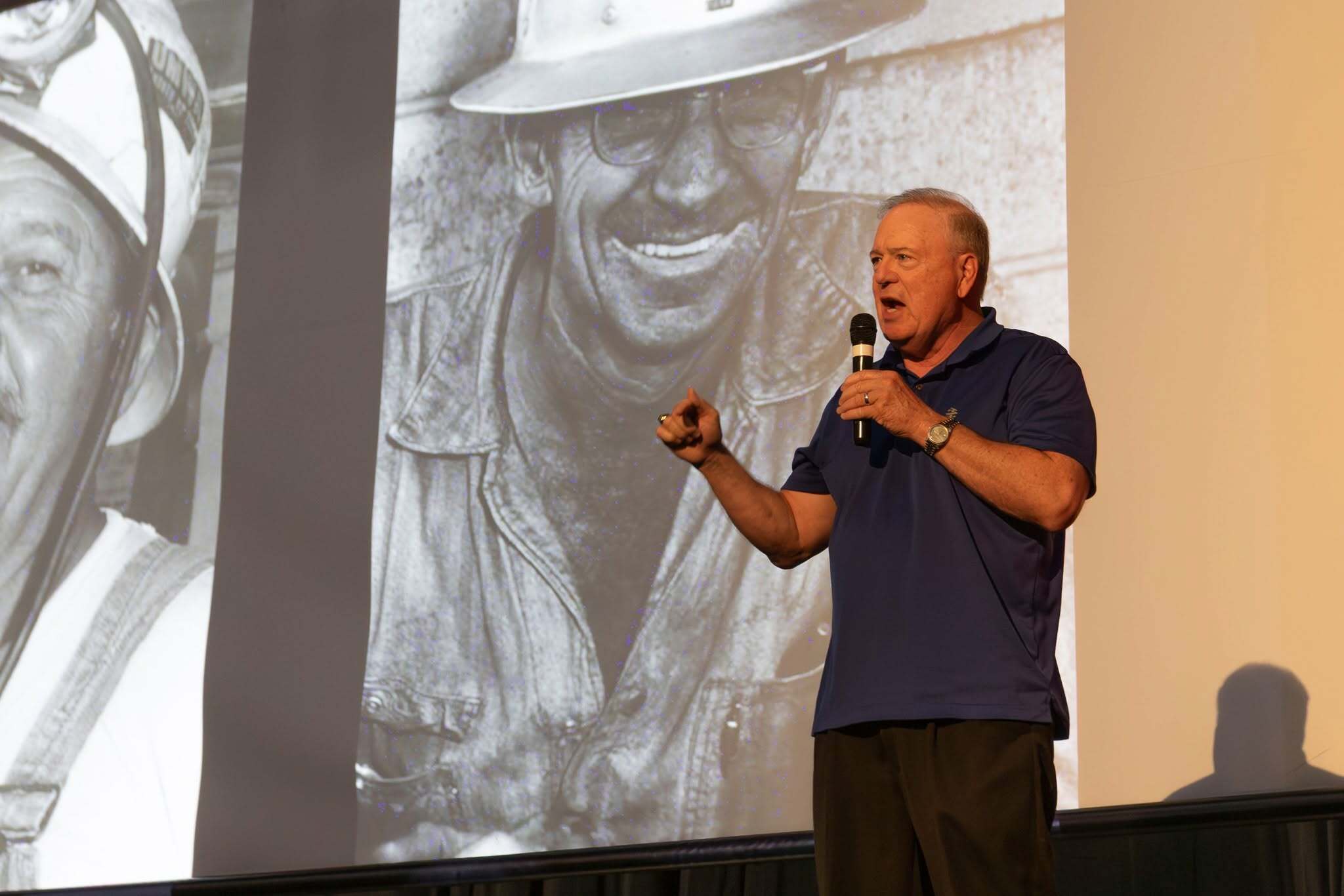
The lives, struggles and achievements of Southern Illinois union coal miners took center stage August 30 at West Frankfort High School, where the Illinois Labor History Society honored two labor leaders and local students brought miners’ voices to life.
Inducted into the ILHS Union Hall of Honor was John E. Jones (1883–1957), who was brought to the United States from Wales as a child. Jones worked as a miner while continuing his education and went on to perfect “rock dusting”—covering mine walls with shale dust to prevent coal-dust explosions. His safety innovation saved thousands of miners’ lives.
Also inducted was Benny “Chuckie” Wilson, a widely respected Southern Illinois United Mine Workers of America activist and president of UMWA Local 1545.
A highlight of the program was an oral-history readers’ theater performed by three local high school students—two from West Frankfort and one from Marion. Drawing on interviews collected through the University of Illinois’ Coal Workers and Communities Listening Project, the students gave voice to miners’ experiences underground and the lasting impact of coal mining on their families and communities. Jason Hedrick of the Herrin Public Library directed the performance.
Speakers included Illinois AFL-CIO President Tim Drea, himself a former UMWA coal miner; former U.S. Representative Glenn Poshard; and John Gossett of West Frankfort’s Old King Coal Festival.
The gathering also looked ahead to a solemn milestone. December 21, 2026, marks the 75th anniversary of the West Frankfort Orient No. 2 Mine explosion, which killed 119 miners in 1951. The disaster remains one of the deadliest mining accidents in American history and an enduring reminder of why generations of miners organized and fought for safer working conditions.
Along with the Illinois Labor History Society, sponsors included the University of Illinois School of Labor and Industrial Relations Climate Jobs Institute, the Frankfort Area Historical Society, the Southern Illinois Central Labor Council, the Southern Illinois University Special Collections Research Center and the Illinois Humanities Council.
The program preserved more than the history of an industry. Through the stories of miners, the recognition of union activists and the participation of a new generation, it honored the courage, solidarity and working-class culture of Southern Illinois.
Mike Matejka, president of the Illinois Labor History Society. More photos here.